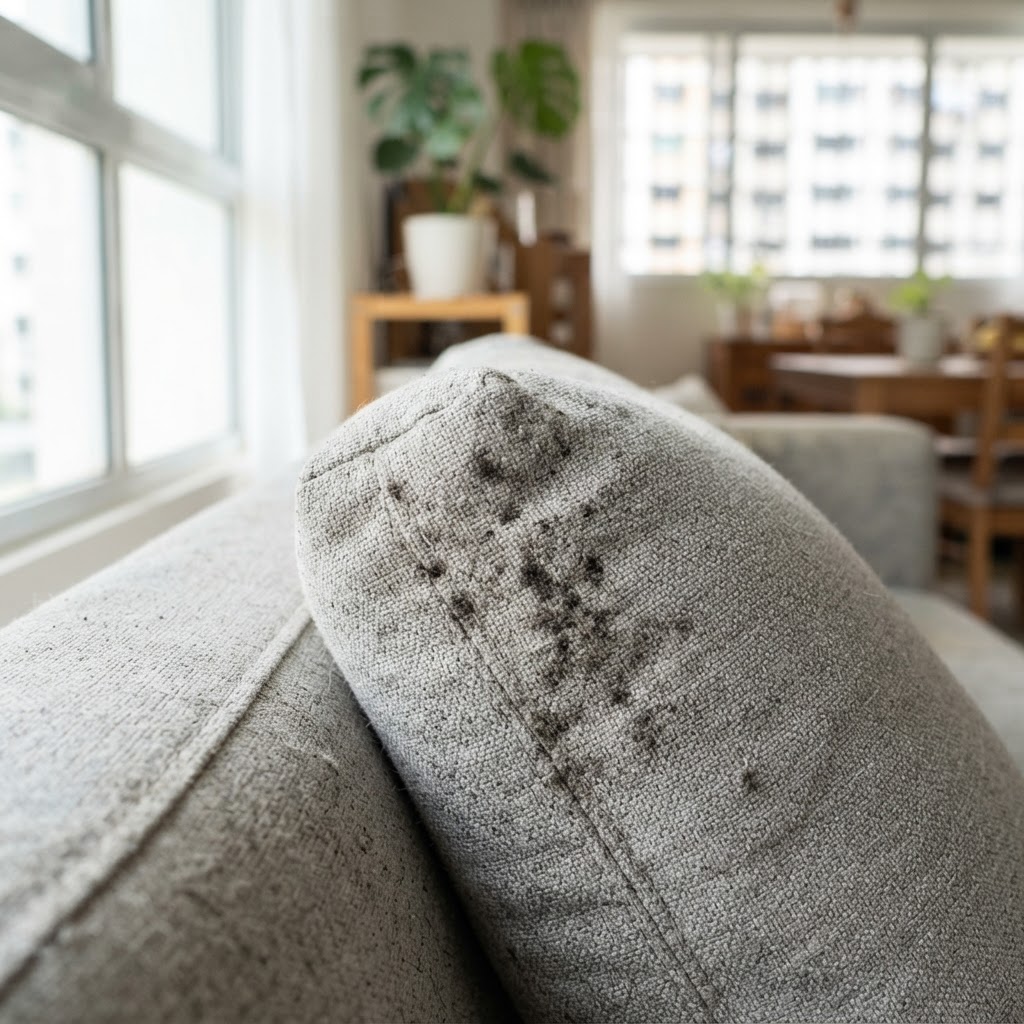
Mould on a fabric sofa is one of the most frustrating discoveries a Singapore homeowner can make. One week the cushions look fine; the next, you spot dark patches spreading across the armrest or along the back cushions. If you've been searching for how to clean a fabric sofa with mould in Singapore, you're in the right place.
Singapore's tropical climate — with relative humidity regularly sitting above 75% — makes fabric upholstery especially vulnerable to mould and mildew. Whether you live in an HDB flat, a condo, or a landed property, poor airflow or a spell of rainy weather is often all it takes for spores to take hold.
Direct answer: To clean a fabric sofa with mould in Singapore, first move it to a ventilated area, vacuum off loose spores with a HEPA-filter vacuum, then treat the affected area with a diluted white vinegar solution or a fabric-safe anti-fungal spray. Allow the sofa to dry completely — ideally with a fan — before using it again. For deep-set mould or large infestations, professional extraction cleaning is safer and more thorough than DIY alone.
Key takeaways
- Singapore's humidity accelerates mould growth on fabric sofas, especially in rooms with limited airflow.
- Never brush dry mould — this releases spores into the air and spreads contamination.
- White vinegar (diluted 1:1 with water) is an effective, fabric-safe first-line treatment for light surface mould.
- Always do a colour-fastness test on a hidden area before applying any cleaning solution.
- Mould that has penetrated deep into the foam or batting requires professional deep extraction — surface treatment alone won't reach it.
- Drying completely after cleaning is critical; residual moisture will cause mould to return.
Why fabric sofas in Singapore are especially prone to mould
Singapore's year-round heat and humidity create near-ideal conditions for mould spores, which are always present in the air. Fabric upholstery acts like a sponge — it absorbs moisture from the air, from sweat, from spilled drinks, and from the occasional wet umbrella left nearby. In an HDB flat with limited cross-ventilation, or a condo bedroom where the aircon is switched off for long periods, that moisture never fully evaporates.
Common contributing factors include:
- Air-conditioning condensation dripping near or on the sofa
- Pets or young children introducing moisture and organic matter
- Sofas placed against exterior or bathroom-adjacent walls
- Extended periods of non-use (e.g. a guest room sofa)
- Flooding or heavy rain entering through open windows
Once mould takes hold in the fabric fibres, it can spread quickly — and the musty smell it produces is hard to ignore.
How to clean a fabric sofa with mould in Singapore: step-by-step
The steps below are suitable for light surface mould on a fabric sofa. If the mould covers a large area, has a strong odour, or has been present for weeks, skip to the professional cleaning section below.
What you'll need
- HEPA-filter vacuum cleaner
- Spray bottle
- White vinegar (undiluted from the supermarket)
- Clean water
- Soft-bristled brush or clean white cloths
- Fan or dehumidifier
- Optional: fabric-safe anti-fungal spray (available at NTUC or hardware shops)
Step-by-step DIY mould removal
- Take the sofa outside or to a well-ventilated area. If that's not possible, open all windows and run a fan. This minimises the spread of spores inside your home.
- Do NOT dry-brush the mould. Brushing loose mould scatters millions of spores. Skip straight to vacuuming.
- Vacuum the affected area using a HEPA-filter vacuum and an upholstery attachment. Work slowly in overlapping strokes. Dispose of the vacuum bag or empty and clean the canister immediately after.
- Colour-fastness test first. Mix equal parts white vinegar and water in a spray bottle. Apply a small amount to an inconspicuous spot — underneath a cushion or on the rear of the sofa — and wait 5 minutes. If the colour bleeds or the fabric distorts, do not proceed with vinegar; switch to a dedicated fabric-safe anti-fungal product.
- Apply the vinegar solution to the mouldy area, spraying lightly rather than soaking the fabric. Let it sit for 10–15 minutes.
- Blot (do not scrub) with a clean white cloth. Work from the outside edge of the mould patch inward to avoid spreading it.
- Rinse with a damp cloth using plain water to remove vinegar residue.
- Dry thoroughly. This is the most important step. Use a fan or dehumidifier directed at the sofa for several hours. In Singapore's humidity, air-drying alone is rarely sufficient — the sofa must feel completely dry to the touch before use.
- Inspect after 24 hours. If mould spots remain or reappear within a few days, the infestation is deeper than surface level and professional treatment is needed.
If you are dealing with a large mould patch, a strong musty smell that persists after cleaning, or if a family member has respiratory sensitivities, this is the point to stop DIY and call in a professional. Singapore-based fabric sofa deep cleaning services use industrial injection-extraction equipment that flushes cleaning solution deep into the upholstery layers and extracts both the moisture and the contamination — something a spray bottle and cloth simply cannot replicate.
What not to do when cleaning mould from a fabric sofa
- Do not use bleach on coloured or patterned fabric. Bleach will strip colour and weaken fibres permanently.
- Do not over-wet the sofa. Soaking the fabric pushes moisture into the foam padding, which dries extremely slowly in Singapore's humidity and creates the exact conditions mould needs to grow back.
- Do not use a hairdryer on high heat. This can shrink fabric or set stains.
- Do not ignore the cushion inserts. If the mould has reached the foam inside removable cushions, the covers alone need to be treated and the inserts may need replacing.
- Do not mask the smell with fabric freshener without treating the mould — the spores remain active and the odour will return.
DIY vs professional mould cleaning: a comparison
| Factor | DIY cleaning | Professional deep cleaning |
|---|---|---|
| Suitable for | Light surface mould, small area | Deep-set mould, large areas, recurring issues |
| Equipment | Household vacuum, spray bottle | Industrial injection-extraction machine |
| Penetration depth | Surface fibres only | Through fabric into padding layers |
| Drying time | 4–8 hours minimum (fan needed) | Faster — extraction removes most moisture |
| Risk of re-growth | Higher if moisture remains | Lower — sanitising treatment included |
| Cost | Very low | From $60 for a 1-seater fabric sofa |
| Effort | Moderate | None — technician handles everything |
For most Singapore households dealing with mould that has been present for more than a week, or mould that reappears after a DIY clean, professional extraction is the more effective and cost-efficient long-term solution.
How to prevent mould from returning on your fabric sofa
Cleaning the mould is only half the job. In Singapore's climate, prevention is an ongoing effort.
- Run the air-conditioning or a dehumidifier regularly, particularly in rooms that are closed up during the day. Keeping indoor humidity below 65% significantly slows mould growth.
- Vacuum your sofa weekly to remove dust, skin cells, and organic matter that feed mould spores. If you're not sure how often to clean, you'll find practical guidance in our article on how often you should clean your sofa — tailored for Singapore households.
- Rotate and air cushions every few weeks, especially reversible cushions.
- Address spills immediately — moisture left in fabric, even a small splash, can be enough to trigger mould growth within 24–48 hours in humid conditions.
- Keep the sofa away from exterior walls where condensation and wall damp can migrate into the fabric.
- Use a fabric protector spray after professional cleaning to create a barrier against moisture and stains.
Cost and pricing for professional sofa mould cleaning in Singapore
SofaCare SG cleans fabric sofas on-site across Singapore with no hidden transport or weekend surcharges. Prices are confirmed before the appointment.
| Sofa type | Starting price |
|---|---|
| 1-seater fabric sofa | $60 |
| 2–3-seater fabric sofa | $87 |
| 4-seater fabric sofa | $107 |
| 5-seater fabric sofa | $127 |
| 3+2 sofa set | $150 |
| L-shaped / sectional sofa | From $87 + $20 add-on |
| Hot steam add-on (sanitising) | From $20 |
For mould cases, the hot steam add-on is worth considering — it delivers high-temperature sanitising treatment that kills residual spores in the fabric. The technician will assess your sofa during the initial inspection and recommend whether this is appropriate.
Note: no cleaning service can guarantee 100% removal of all stains or discolouration caused by mould, particularly where the fabric dye has already been affected. The team will advise you honestly at inspection.
What to expect from a professional fabric sofa mould cleaning
If you book a professional clean, here is what the process typically looks like:
- Inspection and colour-fastness test — the technician examines the sofa, identifies all mould-affected areas, and tests the fabric before any solution is applied.
- Industrial vacuuming — powerful suction removes loose spores, dust mites, and surface debris from all surfaces.
- Targeted pre-treatment — mould-affected areas are treated with an appropriate pre-treatment solution before the main cleaning stage.
- Deep injection and extraction — cleaning solution is injected into the fabric under pressure and immediately extracted, along with moisture, mould, and contaminants from deep within the upholstery layers.
- Sanitising and odour treatment — an anti-microbial sanitising treatment is applied to inhibit future mould and eliminate the musty smell at source.
- Fabric grooming and final inspection — the fabric is groomed back into shape and the technician does a final walkthrough with you before leaving.
Most jobs take 1–2 hours depending on sofa size and severity. The sofa should be allowed to dry for several hours after cleaning — leave a fan running for best results.
Singapore service areas
SofaCare SG cleans fabric sofas island-wide with no transport surcharges, regardless of your location. Service areas include:
East: Bedok, Tampines, Pasir Ris, Simei, Changi, East Coast North: Woodlands, Yishun, Sembawang, Admiralty North-East: Sengkang, Punggol, Serangoon, Hougang, Ang Mo Kio Central: Bishan, Toa Payoh, Novena, Queenstown, Bukit Timah, Holland Village, Clementi West: Jurong, Choa Chu Kang, Bukit Batok, Boon Lay, Tengah
Whether you're in a Tampines HDB, a Bukit Timah landed home, or a Punggol condo, the quote you receive is the price you pay — no surprise fees added at the door.
When to call for same-day or urgent mould cleaning
Mould is not always a problem you can defer to next weekend. If you notice a strong musty smell, visible dark patches spreading across multiple cushions, or a family member is showing signs of respiratory irritation, treating it promptly makes sense.
SofaCare SG can sometimes accommodate same-day bookings subject to availability, with arrival in as little as 3 hours. To check availability and get a firm quote, WhatsApp the team directly — details at the end of this article.
If your household also has a mattress with a musty smell or visible mould (a common related problem in humid Singapore bedrooms), ask about a combined booking. You can find out more about professional mattress cleaning in Singapore and whether it makes sense alongside a sofa clean.
Conclusion: cleaning a fabric sofa with mould in Singapore
To summarise how to clean a fabric sofa with mould in Singapore: start by vacuuming carefully with a HEPA filter, treat with diluted white vinegar after a colour test, blot rather than scrub, and dry thoroughly with a fan. These steps work for light surface mould. For anything deeper, recurring, or covering a large area, professional deep extraction cleaning is safer, more effective, and removes the moisture that would otherwise allow mould to grow straight back.
Singapore's humidity means mould prevention is an ongoing habit — regular vacuuming, controlled indoor humidity, and prompt attention to spills will significantly reduce the risk of a repeat problem.
When you're ready for a professional clean, SofaCare SG offers on-site fabric sofa deep cleaning island-wide with transparent pricing and no hidden surcharges.
---
Get a quote today — WhatsApp SofaCare SG at +65 9025 9771 and the team will confirm availability and pricing before your appointment.