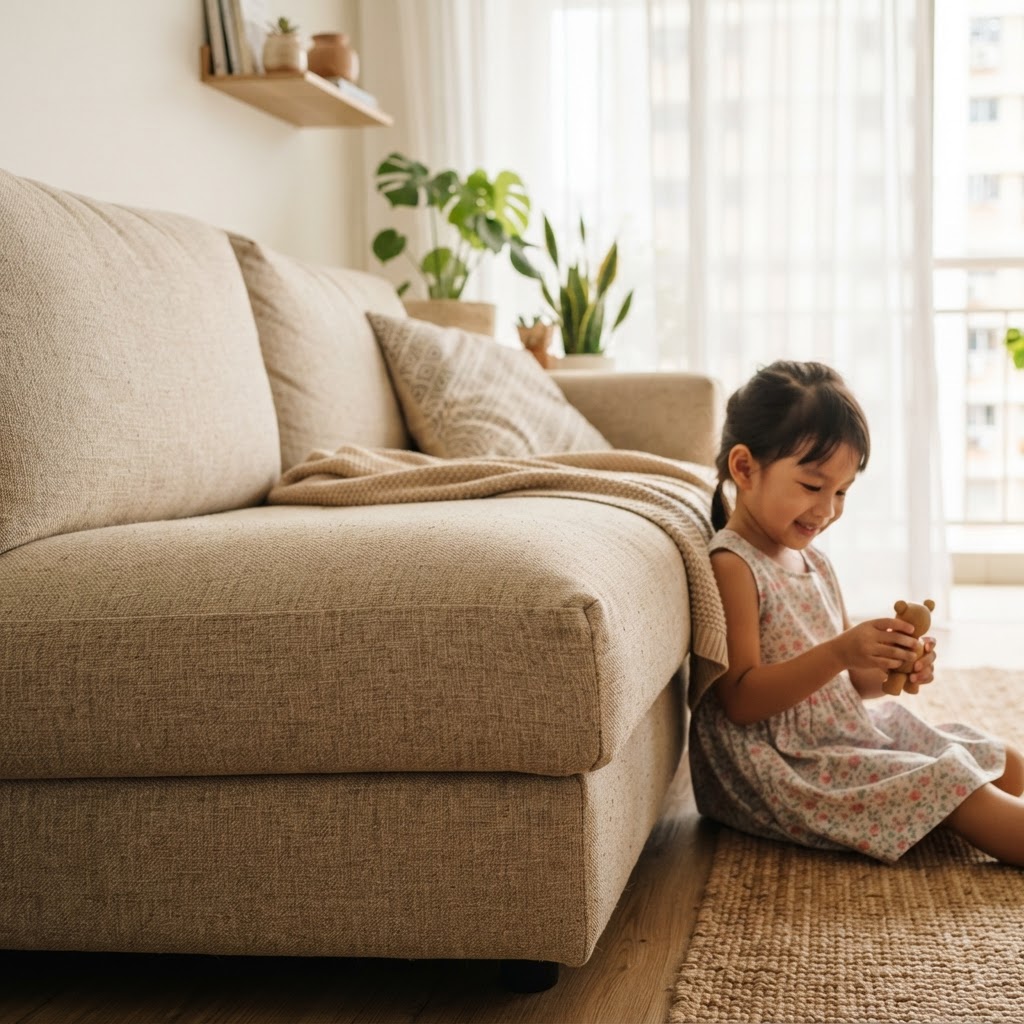
If you or someone in your household sneezes, itches, or wakes up congested every morning, your sofa — not just your mattress — could be the culprit. Dust mite allergy sofa cleaning in Singapore is a genuine, growing need, particularly in our hot, humid climate where mites thrive year-round inside upholstered furniture.
Professional deep cleaning removes the dust mites, their faecal particles and shed skin that trigger allergic reactions. It is the most effective way to reduce allergen load in your sofa because thorough extraction reaches deep into the fabric and foam where vacuuming alone cannot. Regular cleaning — typically every 6 to 12 months — keeps mite populations low and symptoms manageable.
Key takeaways
- Dust mites live deep inside sofa cushions and fabric, not just on the surface — ordinary vacuuming removes only a fraction of them.
- Singapore's humidity (70–90% year-round) creates near-ideal conditions for dust mite reproduction in upholstered furniture.
- Allergy symptoms linked to sofas include sneezing, runny nose, itchy eyes, skin rashes and worsened asthma.
- Professional hot-water extraction combined with industrial vacuuming is the most effective removal method available for home use.
- Fabric sofas harbour significantly more mites than leather or synthetic alternatives.
- Cleaning every 6–12 months is recommended for allergy-prone households; every 3–6 months if you have young children, pets or severe allergies.
Why your sofa is a dust mite hotspot
Most Singapore homeowners focus their allergy concerns on mattresses, and rightly so — but sofas can carry equally high mite populations. The average sofa accumulates dead skin cells, pet dander, food crumbs and moisture from daily use. In an HDB flat or condo where air-conditioning creates warm, still air, dust settles into fabric layers and stays there.
Dust mites feed on shed human skin cells. A single person sheds enough skin daily to feed thousands of mites, and a family sofa used for several hours every evening becomes a feeding ground. The mites themselves are not what cause allergies — it is their faecal pellets and body fragments that become airborne and trigger the immune system.
How Singapore's climate makes it worse
Dust mites thrive at humidity levels above 60% and temperatures between 20–30°C. Singapore sits comfortably within both ranges for most of the year. Even with air-conditioning, sofa interiors rarely cool or dry out fully, especially in landed homes where rooms are larger and ventilation is uneven. Residents in Woodlands, Tampines, Punggol and similar areas with newer, well-sealed HDB blocks or condos often notice that fabric furniture stays slightly damp to the touch in the rainy season — perfect for mite colonies to multiply.
Signs your sofa is causing allergy symptoms
Not every case of dust mite allergy is obvious. Look out for these patterns:
- Symptoms that worsen in the evening or after sitting on the sofa for a while
- Sneezing or itchy eyes that improve when you spend time outdoors or in a different room
- Children or elderly family members with persistent mild respiratory symptoms that doctors cannot link to a specific illness
- A musty or stale smell from your sofa, especially after humid weather
- Visible dust rising when you press on cushions
If this sounds familiar, it is worth booking a professional sofa cleaning in Singapore rather than waiting for symptoms to escalate.
DIY vs professional sofa cleaning for dust mites
Many homeowners reach for a handheld vacuum or a fabric spray first. These help at the surface level, but they do not address the deep allergen load inside foam and batting layers.
| Method | Allergen removal depth | Mite population reduction | Drying time | Cost |
|---|---|---|---|---|
| Handheld vacuum | Surface only | Low | None | Low |
| Fabric spray / anti-allergen spray | Surface only | Low–moderate | 30–60 min | Low |
| Steam cleaner (home-grade) | Partial | Moderate | 2–4 hours | Medium |
| Professional deep extraction | Deep into foam and fabric | High | 2–4 hours | Medium–high |
Professional cleaning combines industrial-grade vacuuming, deep injection of cleaning solution and high-pressure extraction that draws out allergens, debris and moisture from layers a domestic machine cannot reach. For households where a family member has diagnosed dust mite allergy or asthma, the difference in outcomes is meaningful.
What to expect from a professional dust mite sofa cleaning session
If you have never booked a professional upholstery clean before, here is exactly what the process looks like:
- Inspection and colour-fastness test — The technician checks the fabric type and tests a hidden area to confirm the cleaning solution will not cause colour bleed or damage.
- Industrial vacuuming — A high-powered vacuum removes loose dust, debris, surface mites and dander before any liquids are applied.
- Targeted pre-treatment — Any visible stains or heavily soiled areas are treated with a specific pre-treatment solution to break down organic matter.
- Deep injection and extraction — Cleaning solution is injected deep into the fabric and foam, then extracted under pressure, pulling allergens, mite waste and moisture out from inside the sofa.
- Sanitising and odour treatment — An anti-bacterial and deodorising treatment is applied, which also addresses mite-related odours and reduces lingering allergens.
- Fabric grooming and final inspection — Fibres are brushed back into shape and the sofa is inspected before the technician leaves.
Drying typically takes 2–4 hours. Good airflow — open windows, a standing fan or air-conditioning — speeds this up. The sofa is safe for use once it is fully dry.
Is it safe for babies, toddlers and pets?
Yes. Once the sofa is dry, the treated surface is safe for children and pets. If you have a baby or toddler who tends to put their mouth on cushions, simply ensure the sofa is fully dry before allowing contact. If you have specific concerns about particular cleaning agents, mention this when requesting your quote via WhatsApp — the team can advise on the solutions used.
How often should allergy-prone households clean their sofa?
Frequency depends on your household profile. Use this as a guide:
| Household type | Recommended cleaning frequency |
|---|---|
| Single adult, no pets | Every 12 months |
| Couple, no pets or children | Every 9–12 months |
| Family with children (school-age) | Every 6–9 months |
| Family with babies or toddlers | Every 3–6 months |
| Household with diagnosed dust mite allergy or asthma | Every 3–6 months |
| Household with indoor pets | Every 3–6 months |
These are baseline guides. If symptoms persist between cleans, or if you notice that musty smell returning sooner than expected, book an earlier session. Singapore's climate means allergen build-up can happen faster here than in cooler, drier countries.
Cost and pricing
All prices below are genuine starting rates with no hidden transport, location or weekend surcharges. Your final quote is confirmed before any appointment is booked.
| Sofa type | Starting price |
|---|---|
| 1-seater fabric sofa | $60 |
| 2–3-seater sofa | $87 |
| 4-seater sofa | $107 |
| 5-seater sofa | $127 |
| 3+2 set | $150 |
| L-shaped / sectional (add-on) | +$20 |
| Hot steam add-on | From $20 |
For allergy-driven cleaning, the hot steam add-on is worth considering. Steam treatment raises surface temperature to levels that kill dust mites on contact, complementing the deep extraction process. Ask about this option when you request your quote.
If you are also concerned about your mattress — another major dust mite reservoir — you may want to look at mattress cleaning in Singapore alongside your sofa booking. Mattress cleans start from $80 for a single and $87 for a queen.
Fabric vs leather: which sofa type is worse for allergies?
Fabric sofas are significantly worse for dust mite accumulation. Woven fibres trap skin cells, moisture and debris in a way that smooth leather or faux-leather surfaces do not. If you own a fabric sofa and have a family member with diagnosed allergies, frequent professional cleaning is the most practical mitigation short of replacing the sofa entirely.
Leather sofas still need cleaning — skin oils, sweat and surface dust accumulate — but the allergen load is substantially lower. For leather upholstery care, different cleaning agents and techniques apply; discuss this when booking.
Between professional cleans: practical steps to reduce dust mites
Professional cleaning resets the allergen baseline, but good habits between sessions slow re-infestation:
- Vacuum weekly using a vacuum cleaner with a HEPA filter. Standard vacuum bags recirculate fine particles; HEPA filtration captures them.
- Keep indoor humidity below 70% using air-conditioning or a dehumidifier. Mites struggle to reproduce at lower humidity levels.
- Use washable sofa covers and wash them at 60°C or above every 2–4 weeks. High temperature kills mites that vacuuming misses.
- Air your sofa by opening windows on dry, breezy days — sunlight and airflow reduce moisture in fabric.
- Avoid eating on the sofa to reduce the organic material mites feed on.
- Groom pets regularly and limit their time on upholstered furniture if possible.
These steps will not eliminate dust mites entirely in a Singapore home, but they meaningfully reduce population size between professional deep cleans.
Singapore service areas
SofaCare SG serves all areas across Singapore island-wide with no transport surcharges, no weekend surcharges and no location-based fees. Whether you are in Bedok, Tampines or Pasir Ris in the east; Woodlands, Yishun or Sembawang in the north; Sengkang, Punggol or Serangoon in the north-east; Bishan, Toa Payoh or Queenstown in the central region; or Bukit Timah, Jurong, Choa Chu Kang, Clementi or Holland Village in the west — the price you are quoted is the price you pay.
Quotes are provided via WhatsApp before any appointment is confirmed, so there are no surprises on the day.
Conclusion: dust mite allergy sofa cleaning in Singapore is practical and affordable
Dust mite allergy sofa cleaning in Singapore is one of the most direct ways to reduce allergen exposure for your household — particularly in our climate, where mites reproduce year-round. A professional deep clean extracts what surface vacuuming cannot reach, sanitises the fabric and gives your sofa a reset that lasts 6–12 months with basic maintenance habits in between. For families with young children, asthma sufferers or anyone whose allergy symptoms seem tied to time spent on the couch, it is an investment in daily comfort rather than a luxury.
For related guidance on keeping your upholstered furniture in good condition, the upholstery cleaning Singapore overview covers fabric types, care considerations and what to expect from different cleaning methods.
WhatsApp +65 9025 9771 to get a firm quote for your sofa — no obligation, no hidden fees.