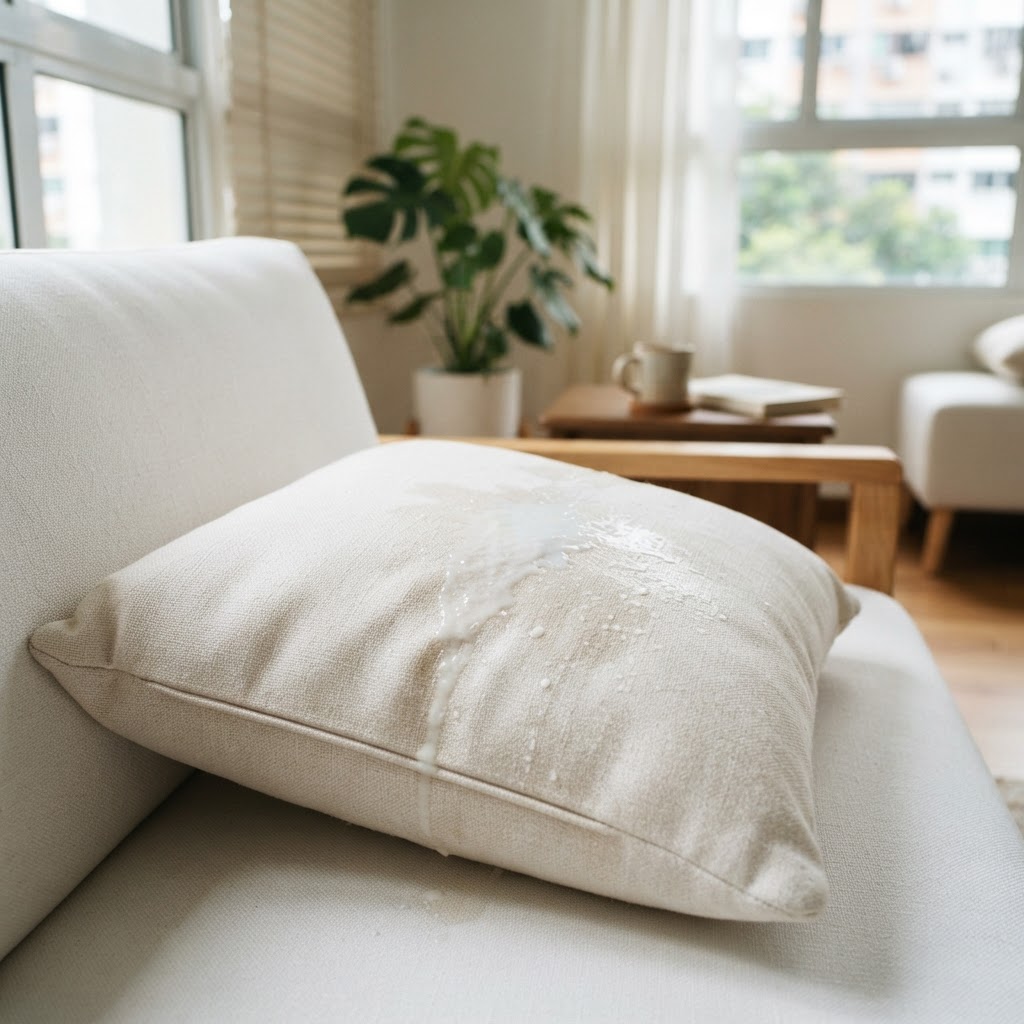
Spilled milk on your sofa is one of those accidents that feels minor until it isn't. In Singapore's hot, humid climate, milk proteins and fats begin to sour and break down within a few hours — especially if the liquid soaks into the foam or batting beneath your upholstery. Acting quickly makes a real difference between a fully fresh sofa and one that carries a persistent, sour smell no amount of air-freshener can fix.
The most important thing to know about a milk spill on sofa cleaning in Singapore is this: blot immediately, treat with a mild cleaning solution, and if the spill is large or has already dried, book a professional deep clean the same day. DIY steps handle surface milk effectively, but only hot water extraction fully removes milk residue from the inner layers of sofa fabric or foam.
Key takeaways
- Blot — never rub — milk the moment it spills to prevent it spreading deeper into the fabric.
- Singapore's tropical humidity speeds up bacterial growth and sour odour; treat within 30 minutes if possible.
- A mixture of cool water and mild dish soap works for fresh surface spills on most fabric sofas.
- Dried or large spills, and any spill on leather, foam-heavy cushions or delicate upholstery, benefit most from professional cleaning.
- Professional sofa cleaning in Singapore starts from $60 for a 1-seater and can reach your home in as little as 3 hours, subject to availability.
- Sour milk odour that lingers after DIY treatment almost always means milk has reached the inner foam — a professional extraction is the only reliable fix.
Why milk spills are different from other sofa stains
Most drink spills are mostly water. Milk is different: it contains fat, protein (casein) and lactose. When these compounds soak into fabric fibres and cushion foam, they begin to ferment and break down. In a temperature-controlled home overseas this might take a day or two. In Singapore, where indoor humidity regularly sits above 70% and ambient temperatures rarely drop below 26°C, the same process can produce a noticeable sour smell within two to four hours.
Baby formula spills are an even stronger version of the same problem. Formula is more calorie-dense than regular milk, with a higher fat and protein concentration that clings to fabric fibres and smells more intensely once it sours. If you have young children and your sofa sees regular feeding accidents, a periodic professional deep clean is worth building into your routine.
Immediate steps: what to do the moment milk spills
Do these steps in order. Speed matters more than any particular product.
- Blot immediately. Use a clean, dry white cloth or several layers of kitchen paper. Press firmly and lift — do not rub, which drives milk deeper into the fibres. Work from the outside of the spill inward.
- Remove as much liquid as possible. Keep blotting with fresh sections of cloth until you are lifting very little moisture. This step alone removes the majority of the milk before it can soak through.
- Mix a mild cleaning solution. Combine one teaspoon of mild dish soap (colourless if possible) with one cup of cool water. Do not use hot water — heat sets protein stains and makes the smell worse.
- Apply sparingly and blot. Dampen a clean cloth with the solution and blot the stained area. Work gently. Rinse the cloth frequently.
- Rinse with cool water. Use a fresh damp cloth with plain cool water to remove soap residue. Soap left in the fabric attracts dirt.
- Dry thoroughly. Use a dry towel to absorb remaining moisture, then direct a fan at the area or open a window. In Singapore's humid air, slow drying is itself a mould and odour risk — do not leave the sofa damp.
- Check after 30 minutes. Once the fabric is nearly dry, smell the area closely. A faint sourness means milk residue remains in the foam. At this point, DIY methods have limited further effect.
For leather sofas, skip the dish-soap solution. Use a damp cloth only, blot thoroughly, and dry gently — then consider a leather-appropriate conditioner. Avoid soaking any leather surface.
When DIY is not enough: signs you need professional cleaning
DIY steps work well on a small, fresh spill caught within minutes. They have real limits. Consider booking a professional if:
- The spill was large (an entire cup or bottle) or soaked through to the cushion foam.
- More than 30–60 minutes passed before you started cleaning.
- The milk was formula, full-fat or condensed milk.
- You can still smell sourness after the sofa has fully dried.
- The sofa fabric is velvet, microfibre, chenille or another delicate weave where vigorous blotting risks damage.
- The sofa is leather or faux-leather and you are unsure of its care requirements.
- The spill happened on a sofa that already has prior staining or odour from other accidents.
Persistent sour odour after DIY treatment is the clearest signal. That smell means fermented milk residue has reached the inner foam, which you simply cannot rinse out by hand. For this situation, hot water injection and extraction — the kind used in professional sofa cleaning in Singapore — is the most reliable method to flush residue from deep inside the cushion and neutralise odour at the source.
What professional milk-spill sofa cleaning involves
When a technician arrives for a milk-spill job, the process typically follows these stages:
- Inspection and colour-fastness test. The technician checks the fabric type and tests a small hidden area to confirm the cleaning solution will not affect the colour.
- Industrial vacuuming. Dry particulate matter, dust mites and surface debris are removed before wet treatment begins — important in Singapore HDB flats and condos where dust accumulates quickly.
- Targeted pre-treatment. A specialised solution is applied to the milk-affected area to break down protein and fat residue.
- Deep injection and extraction. Hot water is injected into the fabric and foam under pressure, then immediately extracted along with the dissolved residue. This is the step that reaches what your cloth cannot.
- Sanitising and odour treatment. An antimicrobial treatment neutralises bacteria responsible for the sour smell, leaving the fabric fresh rather than just surface-clean.
- Fabric grooming and final inspection. The technician checks the result and grooms the fabric to restore its appearance.
Most sofa cleaning visits take 60–90 minutes. Fabric sofas are typically dry enough to sit on again within 2–4 hours depending on ventilation, though using a fan speeds this up considerably in Singapore's humidity.
DIY vs professional cleaning: a quick comparison
| Factor | DIY blotting and spot-clean | Professional deep clean |
|---|---|---|
| Best for | Small fresh spills caught quickly | Large, soaked or dried spills; persistent odour |
| Reaches inner foam? | No | Yes — injection and extraction |
| Removes sour odour fully? | Partial, surface only | Yes, including foam layer |
| Safe for all fabric types? | Risk on delicates | Technician tests first |
| Cost | Household supplies | From $60 (1-seater) |
| Time | 20–30 min | 60–90 min on-site |
| Drying time | 1–3 hours | 2–4 hours |
Cost and pricing for sofa cleaning in Singapore
All prices below are starting rates. Final quotes are confirmed before the appointment — no hidden transport, location or weekend surcharges apply across Singapore.
| Sofa type | Starting price |
|---|---|
| 1-seater | $60 |
| 2–3-seater | $87 |
| 4-seater | $107 |
| 5-seater | $127 |
| 3+2 set | $150 |
| L-shaped / sectional | $20 add-on |
| Hot steam add-on | From $20 |
For a milk spill that has soaked into the foam, the hot steam add-on is worth considering — the elevated temperature helps deodorise the foam layer alongside the extraction process.
If your sofa sits on a stained carpet that also caught milk, note that carpet cleaning starts from $77, which can be combined in the same visit. You can also check the SofaCare pricing page for the full current rate list.
Fabric and leather sofas: different needs
Fabric sofas (including microfibre, chenille, linen)
Fabric sofas are the most common type in Singapore HDB flats and condos, and they are also the most absorbent. Milk soaks quickly through fabric weave into the padding below. Microfibre in particular can feel dry at the surface while remaining damp inside, which gives a false impression that the DIY clean worked. If you own a microfibre sofa and the spill was more than a small splash, a professional clean is the safer call.
Leather and faux-leather sofas
Leather does not absorb liquid as readily as fabric, which is one reason many families with young children choose it. However, if milk sits on the surface and is not wiped up promptly, the acids and fats in milk can cause surface discolouration or cracking over time, particularly on genuine leather. Wipe up any milk from leather immediately with a dry cloth, then a lightly damp cloth. Do not use dish soap or any acidic cleaner. A professional clean is advisable if the milk pooled in seams or ran under a cushion onto the fabric base.
Singapore-specific considerations: humidity, HDBs and families
Singapore's climate is genuinely relevant here, not just background information. At 80–90% relative humidity on a wet day, even a small amount of moisture left in sofa foam creates ideal conditions for mould and bacteria within 24–48 hours. Families in poorly ventilated HDB flats in areas like Woodlands, Yishun, Tampines, Sengkang or Bedok sometimes find that a milk spill they thought was dealt with returns as a musty, sour odour weeks later — because residual moisture deep in the cushion never fully dried.
If you live on a lower floor, have minimal cross-ventilation, or your sofa sits in an air-conditioned room that is switched off at night, drying time after any spill is significantly longer. These households benefit most from professional extraction, which removes moisture rather than simply evaporating it.
SofaCare serves all Singapore neighbourhoods island-wide — including East Coast, Pasir Ris, Punggol, Serangoon, Bishan, Toa Payoh, Queenstown, Bukit Timah, Jurong, Choa Chu Kang, Clementi, Holland Village and more — with no transport or location surcharges regardless of where you are.
If your family also experiences milk or food spills in the car — common with young children on school runs — it may be worth addressing car interior hygiene separately. Singapore parents who manage both home and vehicle upkeep often find it practical to schedule both on the same day.
How often should you deep-clean a sofa with young children?
For households with babies or toddlers where milk, formula and food spills are frequent, a professional deep clean every 6 months is a reasonable baseline. If your sofa handles multiple spills a month, quarterly cleaning keeps odour and bacteria from accumulating between incidents.
For households without children or pets, an annual professional clean is generally sufficient — provided surface spills are dealt with promptly when they happen. You can read more about general guidance in the sofa cleaning frequency and care guide if you want to build a maintenance plan for your specific situation.
Conclusion: act fast, and know when to call for help with milk spill on sofa cleaning in Singapore
A milk spill on your sofa in Singapore needs immediate attention — blot it up, treat the surface, and dry the area as quickly as possible. For a small, fresh spill caught within minutes, those steps are often sufficient. But if the spill was large, has already dried, or you can still smell sourness after the sofa dries, the milk has reached the inner foam and DIY cleaning will not resolve it. A professional deep clean using hot water injection and extraction is the reliable solution, and it starts from $60 for a 1-seater with no hidden surcharges anywhere in Singapore.
Don't let a milk spill on your sofa become a long-term odour problem — same-day help is available, subject to slot availability.
WhatsApp SofaCare at +65 9025 9771 for a fast quote and to check availability today.