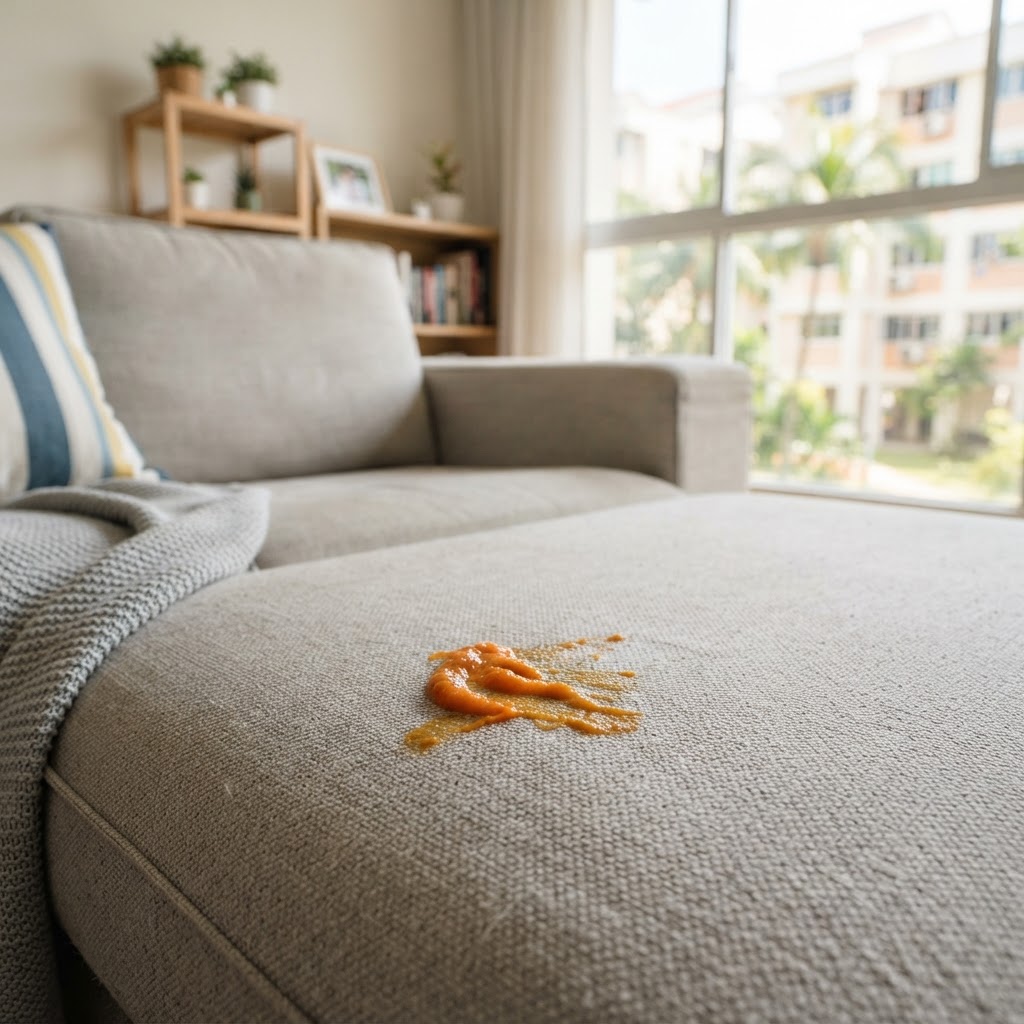
Baby food stains on sofas are one of the most common calls parents make after the weaning stage begins. Whether it is a streak of orange carrot puree, a smear of mashed banana, or a splash of infant formula, these stains share a frustrating trait: they look minor at first, then harden into a stubborn discolouration within hours — especially in Singapore's warm, humid climate where organic matter breaks down quickly and can leave behind both a visible mark and an unpleasant odour.
Prefer to have it done for you? Our sofa cleaning service comes to your home, open 24/7, with a 3-hour call-out around Punggol, Sengkang and Tampines (for example sofa cleaning in Punggol).
Direct answer: To clean a fresh baby food stain from a sofa, blot (never rub) the excess immediately, treat with a small amount of cold water mixed with a drop of mild dish soap, and blot again with a clean white cloth. For dried, deeply set, or repeated stains on fabric or leather sofas, professional hot-steam extraction by a trained cleaner is the most effective and safest solution.
Key takeaways
- Act within minutes: the faster you blot a baby food spill, the less likely it is to set into the fabric fibres or leather surface.
- Always blot — never scrub — to avoid spreading the stain or damaging the weave.
- Singapore's humidity accelerates mould growth under a stain that is not fully dried; ventilation after cleaning is essential.
- Fabric sofas absorb purees more deeply than leather; leather sofas are easier to wipe but can stain around seams and grain lines.
- DIY methods work well for fresh, single stains; repeated stains or discolouration after DIY attempts call for professional extraction.
- Professional sofa cleaning in Singapore typically starts from $60 and removes stain residue, bacteria and odour in a single visit.
Why baby food stains are harder than they look
Baby purees and fortified foods contain natural pigments (beta-carotene in carrot and pumpkin, chlorophyll in pea and spinach), proteins, and simple starches. Each of these behaves differently on upholstery fibres:
- Pigments bind to fabric threads when heat or sunlight is applied — which is why you should never use hot water on a fresh stain.
- Proteins (from dairy-based formulas or egg-based foods) coagulate when they dry, locking them into the fibre structure.
- Starches create a sticky residue that attracts dust and secondary soiling even after the visible stain seems clean.
In a typical Singapore HDB flat or condo, air-conditioning reduces airflow across the sofa, which means stains take longer to dry but also stay moist enough for mould spores to colonise within 24–48 hours if the fabric is not properly treated and dried.
DIY first aid: what to do in the first 10 minutes
These steps apply to fabric sofas. For leather, see the section below.
- Lift excess food immediately. Use a spoon or the blunt edge of a butter knife to scoop away any solid or semi-solid residue. Work from the outside of the stain inward to avoid spreading.
- Blot — do not rub. Press a clean white cloth or plain paper towel firmly onto the stain to absorb moisture. Replace the cloth as it picks up colour.
- Apply a mild cleaning solution. Mix one teaspoon of gentle dish soap (fragrance-free if possible) with one cup of cold water. Dampen a clean cloth with this solution and blot the stained area.
- Rinse with cold water. Use a separate damp cloth with plain cold water to lift the soap residue. Soap left in the fabric can attract dirt over time.
- Blot dry and ventilate. Press a dry towel onto the area to absorb as much moisture as possible. Open windows or use a fan to speed drying — do not sit on the sofa until it is fully dry.
- Check after drying. Some stains only become visible once the fabric dries. If a mark remains, do not apply more product without testing it on a hidden area first.
If the stain has already dried before you found it, loosen it first by dampening the area with cold water and letting it sit for two to three minutes before following the steps above. Avoid biological enzyme cleaners on leather or on delicate fabric blends without checking the care label.
For professional help with stubborn or recurring stains, the Sofa Care Singapore sofa cleaning service covers all fabric and leather sofas island-wide with no transport surcharge.
Cleaning baby food off a leather sofa
Leather requires a gentler approach because harsh detergents strip natural oils and cause cracking.
- Wipe fresh spills immediately with a soft damp cloth. Leather is less porous than fabric but baby food pigments can stain along seams and grain lines if left for more than a few minutes.
- Use a small amount of leather-safe cleaner (or a very diluted, pH-neutral soap) on a cloth — never apply directly to the leather surface.
- Dry thoroughly with a clean towel and allow the sofa to air at room temperature. Avoid direct sunlight or a hairdryer, which can dry out and crack the leather.
- Condition after cleaning. A light application of leather conditioner restores the oils that cleaning removes.
For significant pigment staining (turmeric, carrot or spinach-based purees are the worst offenders on light-coloured leather), professional treatment is strongly recommended. Attempting to scrub or bleach a leather stain at home almost always worsens the damage.
Fabric vs leather sofas: DIY difficulty at a glance
| Factor | Fabric sofa | Leather sofa |
|---|---|---|
| Initial absorption | Absorbs puree quickly | Sits on surface briefly |
| Fresh stain DIY ease | Moderate — blotting works well | Easy — wipe immediately |
| Dried stain DIY ease | Harder — fibres lock in pigment | Hard — pigment sets in grain |
| Mould risk (Singapore humidity) | High if not fully dried | Lower, but seams can trap moisture |
| Risk of DIY damage | Low with correct method | Moderate — soap strips oils |
| Professional benefit | High — extraction removes residue | High — safe for leather conditioning |
When DIY is not enough: signs you need professional sofa cleaning
Some baby food stains genuinely cannot be fully resolved at home. Consider booking a professional cleaner when:
- The stain remains discoloured after two or more DIY attempts.
- You can still smell a sour or musty odour after the sofa has dried — this usually means organic residue remains in the deeper layers of the foam or batting.
- The stain covers a large area or has been there for several days.
- Your sofa fabric is delicate (velvet, microfibre, boucle) or has a "dry clean only" label.
- Multiple baby food stains have accumulated across the same sofa over weeks or months of weaning.
Parents in Singapore dealing with the full weaning journey — which can last six months or more — often find that a mid-way professional deep clean and a final clean after the messiest phase ends is the most practical approach.
If you have also had milk spills or vomit incidents alongside the food stains, you may find the guidance on milk spill sofa cleaning in Singapore useful for understanding how protein-based stains behave differently and why a combined treatment is more efficient than addressing each stain separately.
What a professional baby food stain treatment involves
When Sofa Care Singapore attends a baby food stain job, the process follows these stages:
- Inspection and colour-fastness test — the technician checks fabric type, existing damage, and tests the cleaning agent on a hidden section to confirm colour stability.
- Industrial vacuuming — removes dried food particles, dust, and any loose debris from the surface and seams before wet treatment begins.
- Targeted stain pre-treatment — a suitable agent is applied directly to stained areas and allowed to dwell, breaking down pigments and protein residue.
- Deep injection and hot-steam extraction — cleaning solution is injected into the fabric and immediately extracted along with the dissolved stain matter. This step also reaches the foam layer where odours and bacteria often accumulate.
- Sanitising and odour treatment — a sanitising agent neutralises bacteria from food residue, particularly important for sofas used by infants.
- Fabric grooming and final inspection — the pile or weave is brushed back into alignment and the technician reviews the result with you before leaving.
Drying typically takes one to three hours in a well-ventilated Singapore home. Running the air-conditioning on fan mode (without cooling) speeds the process.
Cost and pricing
All prices below are Sofa Care Singapore's current starting rates. The final quote is confirmed before any appointment is booked, with no hidden transport, location, or weekend surcharges.
| Sofa type | Starting price |
|---|---|
| 1-seater fabric sofa | $60 |
| 2–3-seater fabric sofa | $87 |
| 4-seater fabric sofa | $107 |
| 5-seater fabric sofa | $127 |
| 3+2 sofa set | $150 |
| L-shaped / sectional (add-on) | +$20 |
| Hot steam add-on | From $20 |
Leather sofa pricing is quoted on request. For households with multiple stained cushions or a sofa that has seen months of weaning, a hot-steam add-on is often worth the small additional cost — it reaches bacteria and odour deep in the fill that surface extraction alone may not fully address.
For a full breakdown, the Sofa Care Singapore pricing page lists current rates and common add-ons.
Singapore service areas
Sofa Care Singapore operates island-wide with no transport or location surcharges. If your address is within about 8 km of Punggol, Sengkang or Tampines, you can expect a 3-hour call-out response. For all other Singapore addresses — the rest of the island — same-day service is available.
Families across all major areas are covered, including Bedok, Pasir Ris, Tampines, Sengkang, Punggol, Serangoon, Bishan, Toa Payoh, Queenstown, Buona Vista, Holland Village, Bukit Timah, Clementi, Jurong West, Jurong East, Choa Chu Kang, Yishun, Woodlands, Ang Mo Kio and the East Coast. Whether you live in an HDB flat, condo, or landed home, the team comes to you.
Safety during and after cleaning
Parents naturally worry about chemical residues when infants regularly press their faces into sofa cushions. The cleaning agents used by Sofa Care Singapore are selected to be safe once dry. The key practical points:
- Keep children and pets off the sofa until it is fully dry — typically one to three hours.
- Ventilate the room well during and after cleaning.
- If your child has a known skin sensitivity, mention this when you book so the technician can discuss the products being used.
For families also dealing with mattress hygiene — a common concern when babies transition to sleeping in their own bed — the Sofa Care Singapore mattress cleaning service covers all mattress sizes and can often be booked alongside a sofa clean on the same visit.
Conclusion: tackling baby food stain sofa cleaning in Singapore
Baby food stain sofa cleaning in Singapore does not have to be stressful. Fresh spills respond well to quick blotting and a mild soap solution. Dried, repeated, or large stains — especially those with lingering odour — are best handled by professional hot-steam extraction, which removes not just the visible mark but the bacteria and food residue that DIY methods leave behind. Singapore's humidity makes thorough drying non-negotiable: an improperly dried stain is an invitation for mould.
If you are in the middle of the weaning phase and your sofa is showing the evidence, a single professional clean now is easier, faster, and more effective than attempting multiple rounds of home remedies on a sofa that sees new stains every week.
WhatsApp Sofa Care Singapore at +65 9025 9771 for a fast, no-obligation quote — same-day visits available across all Singapore neighbourhoods.
Our services: sofa cleaning in Singapore · mattress cleaning in Singapore