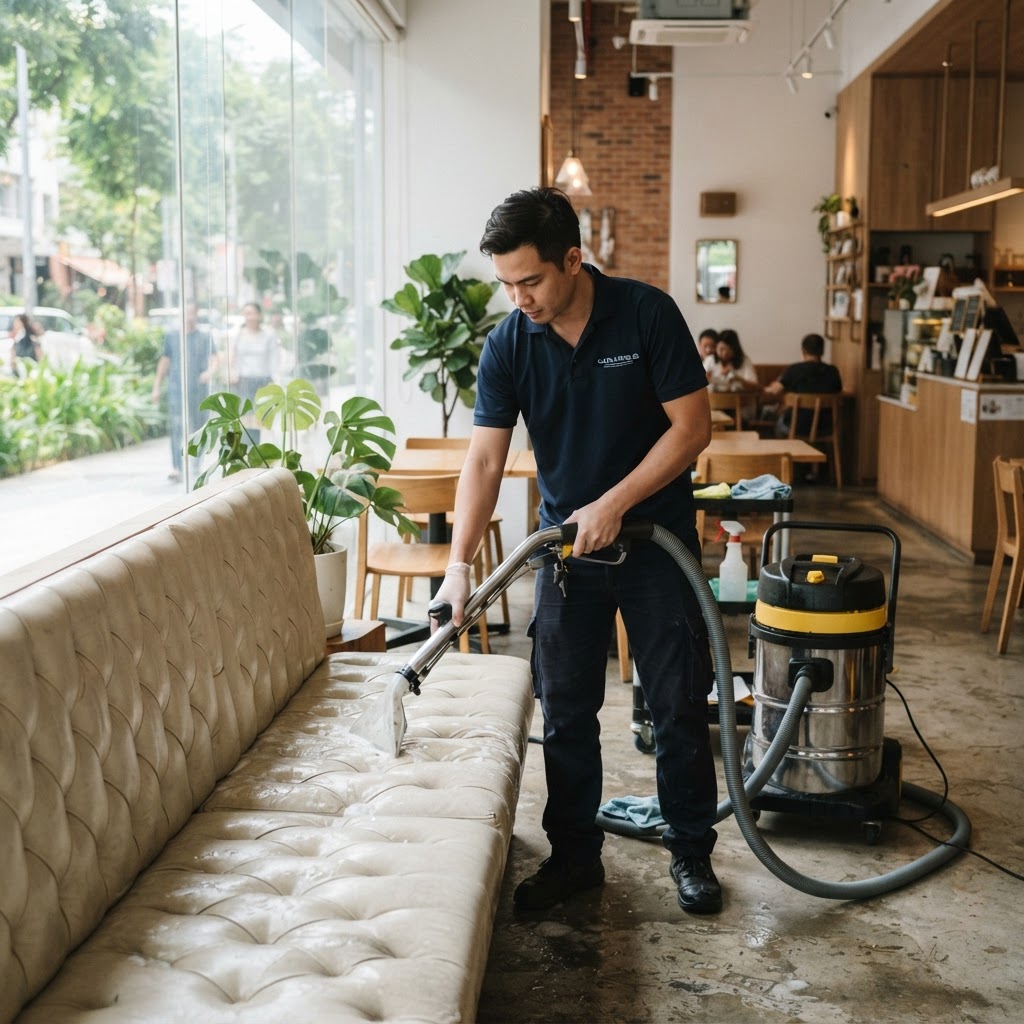
Food and beverage businesses in Singapore face one of the toughest upholstery challenges around. Between kaya toast crumbs, kopi drips, sauce splashes and the sheer volume of daily foot traffic, restaurant booth seating, cafe cushions and bar stools accumulate grime at a rate that ordinary wiping simply cannot address. F&B upholstery cleaning in Singapore is a specialist service that goes beyond a surface wipe-down — it extracts embedded grease, neutralises odour-causing bacteria and restores the appearance of your seating so guests feel comfortable and your brand looks polished.
Professional deep cleaning uses industrial-grade injection and extraction equipment to pull out what has soaked into the foam and fabric layers. For F&B venues, this is not a luxury — it is a hygiene necessity, particularly in Singapore's hot and humid climate where bacteria and mould thrive inside damp upholstery.
Key takeaways
- F&B upholstery — booth seating, bar stools, staff chairs and waiting-area sofas — accumulates grease, food residue and odour-causing bacteria faster than domestic furniture.
- Professional extraction cleaning reaches beyond the surface into padding and backing, which a cloth wipe cannot.
- Singapore's tropical humidity accelerates mould growth inside fabric seating, making regular deep cleaning essential for any food business.
- A professional clean typically takes 1–3 hours depending on piece count and condition; seating is dry and back in use within a few hours.
- No transport or weekend surcharges apply for island-wide service; quotes are confirmed before the appointment.
- Booking via WhatsApp is the fastest way to get a same-day or next-day slot subject to availability.
Why F&B seating gets dirtier faster than domestic upholstery
A sofa at home might be sat on for a few hours a day by the same small group of people. A restaurant booth handles dozens of different guests daily, each bringing food, drinks and outdoor grime. Oils from skin transfer to armrests, sauces seep into seat cushion seams, and sugary drink spills dry into sticky residue that traps further dirt. Over time, the fabric takes on a dull, stained appearance and — more critically — begins to smell.
In Singapore's climate, the combination of air-conditioning condensation and high ambient humidity outside creates moisture cycling inside padded seating. This is ideal for dust mites and mould colonies. A restaurant that does not schedule periodic professional cleaning is essentially serving guests on mould-harbouring furniture, which is a reputational and hygiene risk.
For a broader understanding of how upholstery deteriorates in Singapore conditions and what a deep clean involves, the upholstery cleaning service page walks through the full process and explains what to expect.
Common F&B upholstery types and their cleaning needs
Fabric booth seating
Woven fabric is common in casual dining and cafe settings because it looks warm and inviting. It is also the most absorbent. Liquid spills penetrate quickly, and grease from food bonds with fibres. A colour-fastness test is essential before any wet extraction to ensure the fabric can handle the cleaning agents used.
Vinyl and faux leather
Vinyl is popular in hawker-style restaurants and fast-casual F&B because it wipes down easily for daily cleaning. However, the seams and stitching collect debris, and beneath cracked or peeling vinyl the foam substrate can harbour moisture and odour. Professional cleaning addresses both surface and seam-level grime.
Leather (genuine)
High-end restaurants sometimes use genuine leather for premium seating. Leather requires conditioning alongside cleaning to prevent cracking from Singapore's air-conditioned and outdoor humidity swings.
Bar stools and staff chairs
These tend to be overlooked in routine cleaning schedules. Staff chairs in particular can develop heavy perspiration odour, especially in kitchen-adjacent areas.
| Seating type | Daily wipe effective? | Needs professional extraction? | Recommended frequency |
|---|---|---|---|
| Fabric booth | Partially (surface only) | Yes | Every 3–6 months |
| Vinyl/faux leather | Yes (surface) | Yes (seams & foam) | Every 6 months |
| Genuine leather | Yes (surface) | Yes + conditioning | Every 6–12 months |
| Bar stools (fabric) | Partially | Yes | Every 3–6 months |
| Staff chairs | Partially | Yes | Every 3–6 months |
What a professional F&B upholstery cleaning session involves
Here is what to expect when you book a professional clean for your restaurant or cafe:
- Inspection and colour-fastness test — The technician examines the fabric type, identifies stained or high-wear areas, and tests a discreet patch to confirm the cleaning solution will not affect colour or texture.
- Industrial vacuuming — A heavy-duty vacuum removes loose debris, crumbs and dry particulate from the surface and seams before any moisture is introduced.
- Targeted stain pre-treatment — Grease marks, sauce stains and drink spills are pre-treated with specialist formulas designed to break down food-based soiling.
- Deep injection and extraction — Cleaning solution is injected into the fabric under controlled pressure and then extracted along with dissolved soiling, bacteria and allergens. This is the step that separates a professional clean from a surface wipe.
- Sanitising and odour treatment — An antimicrobial treatment is applied to neutralise odour-causing bacteria and inhibit mould. This is especially important in F&B environments where food odours permeate deeply.
- Fabric grooming and final inspection — The fabric is groomed back into shape and the technician does a final walk-through with you to confirm results.
For heavily soiled pieces with set-in food stains, expect an honest assessment upfront: professional cleaning significantly improves appearance and hygiene, but 100% stain removal cannot be guaranteed on all pieces.
DIY cleaning vs professional extraction: an honest comparison
| Factor | DIY (spray & wipe) | Professional extraction |
|---|---|---|
| Surface soil removal | Good | Excellent |
| Embedded grease removal | Poor | Good–Excellent |
| Odour elimination | Temporary masking | Deep neutralisation |
| Bacteria/mould treatment | Minimal | Antimicrobial treatment |
| Risk of over-wetting | High | Low (controlled extraction) |
| Drying time | Slow (hours to days if over-wet) | Faster (controlled moisture) |
| Cost | Low per session | Moderate, better value long-term |
DIY approaches are useful for immediate spill response — blotting liquid immediately and keeping a surface spray for quick daily touch-ups. But they cannot substitute for periodic extraction cleaning, particularly in a commercial F&B context where hygiene standards matter and furniture investment needs protecting.
If you're ever dealing with a sudden heavy spill at home or in a small cafe setting, the advice in our guide on removing coffee and drink stains from sofas is a practical starting point before a professional clean.
How often should F&B venues schedule upholstery cleaning?
Frequency depends on customer volume and fabric type:
- High-traffic venues (full-service restaurants, busy cafes, bars): every 2–3 months
- Medium-traffic venues (smaller cafes, co-working spaces with seating): every 3–6 months
- Lower-traffic venues (private dining, members' clubs): every 6–12 months
A practical rule: if you can smell the seating from standing height, you are overdue. Singapore's humidity means that what looks superficially clean can already be growing mould inside the foam.
Cost and pricing
Pricing for F&B upholstery cleaning follows the same per-piece structure as residential cleaning. Below are the standard starting prices:
| Piece | Starting price (SGD) |
|---|---|
| 1-seater sofa / armchair | $60 |
| 2–3-seater sofa | $87 |
| 4-seater sofa | $107 |
| 5-seater sofa | $127 |
| 3+2 set | $150 |
| L-shaped / sectional (add-on) | +$20 |
| Hot steam add-on | from $20 |
For commercial F&B jobs involving multiple booth sections, bar stools and staff chairs, the best approach is to send photos and a piece count via WhatsApp for an accurate quote. There are no hidden transport, location or weekend surcharges — the price confirmed before the appointment is the price you pay.
For a full breakdown of all cleaning rates including mattresses and carpets, the SofaCare pricing page has everything in one place.
Singapore service areas
Service covers the entire island with no surcharges for location. Whether your F&B outlet is in the CBD, a suburban mall, or an HDB commercial block, the pricing stays the same. Areas regularly served include:
East: East Coast, Bedok, Tampines, Pasir Ris, Changi North: Woodlands, Yishun, Sembawang North-East: Sengkang, Punggol, Serangoon Central: Bishan, Toa Payoh, Novena, Queenstown West: Jurong, Choa Chu Kang, Clementi, Bukit Timah, Holland Village
For early-morning slots before a venue opens or scheduling around peak service hours, mention your timing preference when you message on WhatsApp and the team will work around your operations.
Practical tips for maintaining F&B upholstery between professional cleans
- Blot, never rub — For liquid spills, blot immediately with a clean dry cloth. Rubbing spreads the stain and pushes it deeper into the fabric.
- Use a fabric protector — After a professional clean, ask about applying a fabric protector treatment that creates a barrier against future liquid absorption.
- Daily spot-check — Train front-of-house staff to note and spot-treat visible spills at the end of each shift rather than leaving them overnight.
- Ventilate between service periods — Where possible, allow seating to air between lunch and dinner service to reduce moisture accumulation.
- Keep records — Note the date of each professional clean; this helps you stay on schedule and is useful documentation for any food hygiene inspection.
Conclusion: professional F&B upholstery cleaning in Singapore is a hygiene standard, not a luxury
For any food and beverage business in Singapore, the condition of your seating communicates something to every guest who sits down. F&B upholstery cleaning in Singapore — done professionally with injection and extraction equipment — is the only way to genuinely remove embedded grease, neutralise food odour and treat mould risk in a tropical climate. Surface wiping maintains appearances briefly; deep cleaning protects the furniture investment, meets hygiene expectations and keeps the dining environment genuinely fresh.
Schedule cleans based on your traffic volume, respond to spills immediately, and book professional extraction every few months to stay ahead of the build-up. The result is seating that looks better, lasts longer and creates a better impression for every guest who walks through your door.
WhatsApp SofaCare SG at +65 9025 9771 to send photos of your F&B seating and get a confirmed quote — slots are available island-wide, including same-day where available.