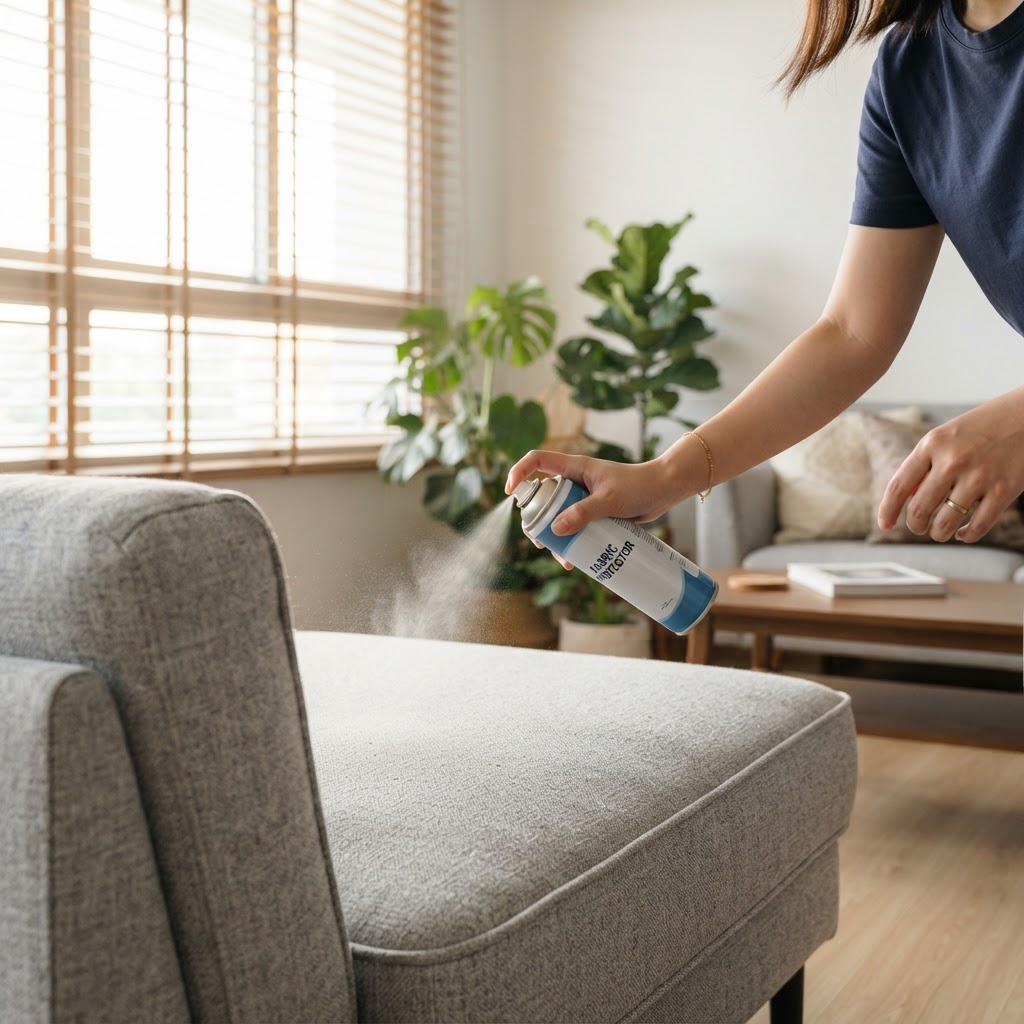
Fabric protection treatment after sofa cleaning is one of the most overlooked steps in upholstery care — and in Singapore's hot, humid climate, skipping it can mean your freshly cleaned sofa picks up new stains and odours within weeks. Whether you live in a HDB flat in Tampines, a condo in Bukit Timah or a landed home in Serangoon, applying a fabric protector right after a professional deep clean gives your upholstery a fighting chance against spills, dust mites and tropical moisture.
A fabric protection treatment works by coating individual fabric fibres with a water- and oil-repellent barrier. Stains bead on the surface rather than soaking in, making them far easier to blot away before they set. The treatment is most effective when applied immediately after deep cleaning, because the fibres are free of embedded soil and the protector bonds cleanly to the fabric.
Key takeaways
- Apply fabric protection treatment immediately after sofa cleaning, while fibres are clean and open, for the best bonding and longest-lasting coverage.
- Singapore's year-round humidity (75–85% RH) accelerates fabric degradation, mould growth and dust-mite proliferation — a protector slows all three.
- Professional-grade fabric protectors outperform supermarket sprays in durability and coverage depth.
- Most treated sofas in average Singapore households should be re-treated every 12–18 months, or after each professional clean.
- Fabric protection is safe for children and pets once the treatment has fully dried — typically 2–4 hours.
- Combining deep cleaning with a protection treatment in a single visit is the most cost-effective and time-efficient approach.
Why fabric protection treatment matters after sofa cleaning
When a professional cleans your sofa using hot-water extraction or steam injection, the process removes built-up soil, body oils, dust mites and odour-causing bacteria from deep within the fabric. The fibres emerge clean — but also slightly more porous and receptive to new contaminants. Without a protective barrier applied at this point, your sofa is arguably more vulnerable to rapid re-soiling than it was before the clean.
In Singapore's tropical environment, this matters more than it would in a temperate country. Average relative humidity hovers between 75% and 85% year-round. That moisture, combined with air-conditioner condensation and the natural oils deposited by skin contact, creates ideal conditions for:
- Dust mite re-colonisation — mites thrive above 60% RH and can repopulate a cleaned sofa within weeks if no barrier exists.
- Mould and mildew growth — particularly in HDB flats or condos with limited natural ventilation.
- Deep stain penetration — from common culprits like kopi, milo, curry, child's juice and pet accidents.
A quality fabric protection treatment creates a microscopic shield that repels liquid spills and slows the re-accumulation of airborne particles. It does not make fabric indestructible, but it meaningfully extends the interval between deep cleans and makes routine maintenance far easier.
How fabric protection treatment works: the science explained
Most professional-grade fabric protectors use fluoropolymer or silicone-based chemistry to surround each fibre with a hydrophobic (water-repelling) and oleophobic (oil-repelling) coating. The coating is applied as a fine mist and worked into the weave, then allowed to cure.
When a liquid contacts treated fabric, surface tension causes it to bead rather than wick into the fibre core. You have a window — typically 30 seconds to a few minutes depending on the liquid — to blot the spill away cleanly. Untreated fabric absorbs liquid almost immediately, carrying pigments and oils deep into the weave where they oxidise and bond permanently.
Does fabric protection treatment change how the sofa looks or feels?
A correctly applied professional treatment should be invisible and should not stiffen or alter the texture of the fabric. You may notice that water drops bead on the surface — that is the treatment working as intended. If a treatment leaves a visible residue or noticeable stiffness, it has either been over-applied or is a low-quality product.
What to expect: the step-by-step process
When you book a SofaCare SG deep clean that includes fabric protection treatment, here is what the on-site process looks like:
- Inspection and colour-fastness test — The technician examines the fabric type, checks for existing stains and tests a hidden area to confirm the fabric will not bleed or shrink during treatment.
- Industrial vacuuming — High-powered vacuuming removes loose particulates, pet hair and surface dust from all cushions, seams and crevices.
- Targeted stain pre-treatment — Stubborn stains are treated individually with appropriate cleaning agents before the main clean begins. Note: professional pre-treatment significantly improves results, but 100% stain removal cannot be guaranteed for all stains.
- Deep injection and extraction — Hot water or steam is injected into the fabric at pressure and immediately extracted, flushing embedded soil and allergens out of the weave.
- Sanitising and odour treatment — An antimicrobial solution is applied to address bacteria, mould spores and odour at the source, followed by fabric grooming to restore the pile direction.
- Fabric protection treatment application — With the sofa clean and the fibres fully open, the protector is applied evenly across all fabric surfaces using a controlled spray method and worked in with a soft brush or pad.
- Final inspection — The technician reviews the result with you before leaving. Drying time is typically 2–4 hours under normal Singapore indoor conditions with a fan or air-conditioning running.
DIY fabric protector sprays vs professional treatment
Supermarket fabric protector sprays (brands like Scotchgard are widely available in Singapore) offer a degree of protection, but there are meaningful differences between consumer products and professional treatments.
| Factor | DIY spray | Professional treatment |
|---|---|---|
| Product quality | Consumer-grade formulation | Industrial-grade, deeper fibre penetration |
| Application coverage | Uneven; easy to miss seams and folds | Even, systematic coverage by trained technician |
| Timing | Often applied over partially soiled fabric | Applied immediately after professional deep clean |
| Durability | 3–6 months typical | 12–18 months typical |
| Cost | $15–$30 per can | Add-on to professional clean |
| Safety testing | Varies by brand | Applied by trained professional |
The most important variable is timing. Applying any protector over a sofa that has not been professionally deep cleaned first is like painting over a dirty wall — the barrier sits on top of embedded grime rather than bonding to clean fibre. If your sofa has not been deep cleaned in over a year, a DIY spray alone will not deliver meaningful protection.
How often should you reapply fabric protection in Singapore?
The re-application frequency depends on your household profile:
| Household type | Recommended cleaning + protection interval |
|---|---|
| Single adult or couple, no pets | Every 18–24 months |
| Family with young children | Every 12 months |
| Household with pets | Every 9–12 months |
| High-traffic living room (multi-generational household) | Every 9–12 months |
| Rental property / Airbnb | After every tenancy change |
In all cases, reapply protection after every professional deep clean — not as a standalone treatment in between. The clean-then-protect sequence is what makes the treatment work.
Is fabric protection treatment safe for children and pets?
Professional fabric protectors used by reputable services are formulated to be safe once fully cured. The key phrase is *once fully cured*. During application and the drying period (typically 2–4 hours), it is advisable to keep children and pets off the treated sofa and to ventilate the room.
Once dry, the treated surface is inert. There is no ongoing off-gassing or residue transfer under normal contact. If your child or pet tends to chew on sofa fabric, raise that specifically with your technician — some ultra-sensitive households opt for a fragrance-free, lower-VOC formulation.
Cost and pricing for sofa cleaning in Singapore
SofaCare SG provides transparent, no-surprise pricing. There are no transport surcharges, no location fees, and no weekend premiums. Your quote is confirmed before the appointment is booked.
Sofa deep cleaning (fabric)
| Sofa configuration | Starting price |
|---|---|
| 1-seater | $60 |
| 2–3-seater | $87 |
| 4-seater | $107 |
| 5-seater | $127 |
| 3+2 set | $150 |
| L-shaped / sectional (add-on) | +$20 |
Other upholstery and soft furnishings
| Item | Starting price |
|---|---|
| Single / super single mattress | $80 |
| Queen mattress | $87 |
| King mattress | $97 |
| Carpet | $77–$127 |
| Hot steam add-on | From $20 |
Fabric protection treatment pricing is confirmed at quotation stage based on sofa size and fabric type. Booking cleaning and protection together in one visit is the most cost-efficient option — the sofa is already clean and the technician is already on-site.
Singapore service areas: island-wide coverage, no surcharges
SofaCare SG serves all residential and commercial addresses across Singapore with no transport or location surcharges. Whether your sofa is in a HDB flat in Woodlands, Yishun, Bedok, Tampines or Pasir Ris; a condo in Queenstown, Holland Village, Bukit Timah or Bishan; or a landed home in Serangoon, Toa Payoh, Clementi, Jurong, Choa Chu Kang, Punggol or Sengkang — the quoted price is the price you pay.
All quotations are handled via WhatsApp, which makes it easy to share photos of your sofa for a more accurate assessment before the technician arrives.
Maintaining your sofa between professional cleans
Fabric protection treatment does not eliminate the need for basic maintenance, but it makes that maintenance much easier. Between professional cleans:
- Blot spills immediately — do not rub, as rubbing spreads the liquid and pushes it deeper into the fibre.
- Vacuum weekly using a soft upholstery attachment, paying attention to cushion seams where crumbs and dust accumulate.
- Rotate cushions regularly to distribute wear evenly.
- Keep out of direct sunlight where possible — Singapore's UV intensity fades fabric and degrades protective coatings faster.
- Avoid harsh chemical sprays on treated fabric — window cleaners, bleach dilutions and DIY enzyme sprays can strip the protective coating prematurely.
Conclusion: fabric protection treatment after sofa cleaning is a worthwhile investment
Fabric protection treatment after sofa cleaning is not a luxury add-on — in Singapore's climate, it is a practical step that extends the life of your upholstery, reduces allergen re-accumulation and makes everyday spill management significantly easier. The combination of a thorough professional deep clean followed immediately by a quality fabric protector gives your sofa the best possible start and the longest interval before the next clean is needed.
For homeowners and renters across Singapore — from East Coast to Jurong, Woodlands to Punggol — the process is straightforward, transparent and available with no hidden surcharges. If you are already booking a sofa deep clean, adding fabric protection treatment in the same visit is the smartest and most cost-efficient way to protect your investment.
WhatsApp SofaCare SG at +65 9025 9771 to get a no-obligation quote for sofa deep cleaning and fabric protection treatment at your Singapore address.