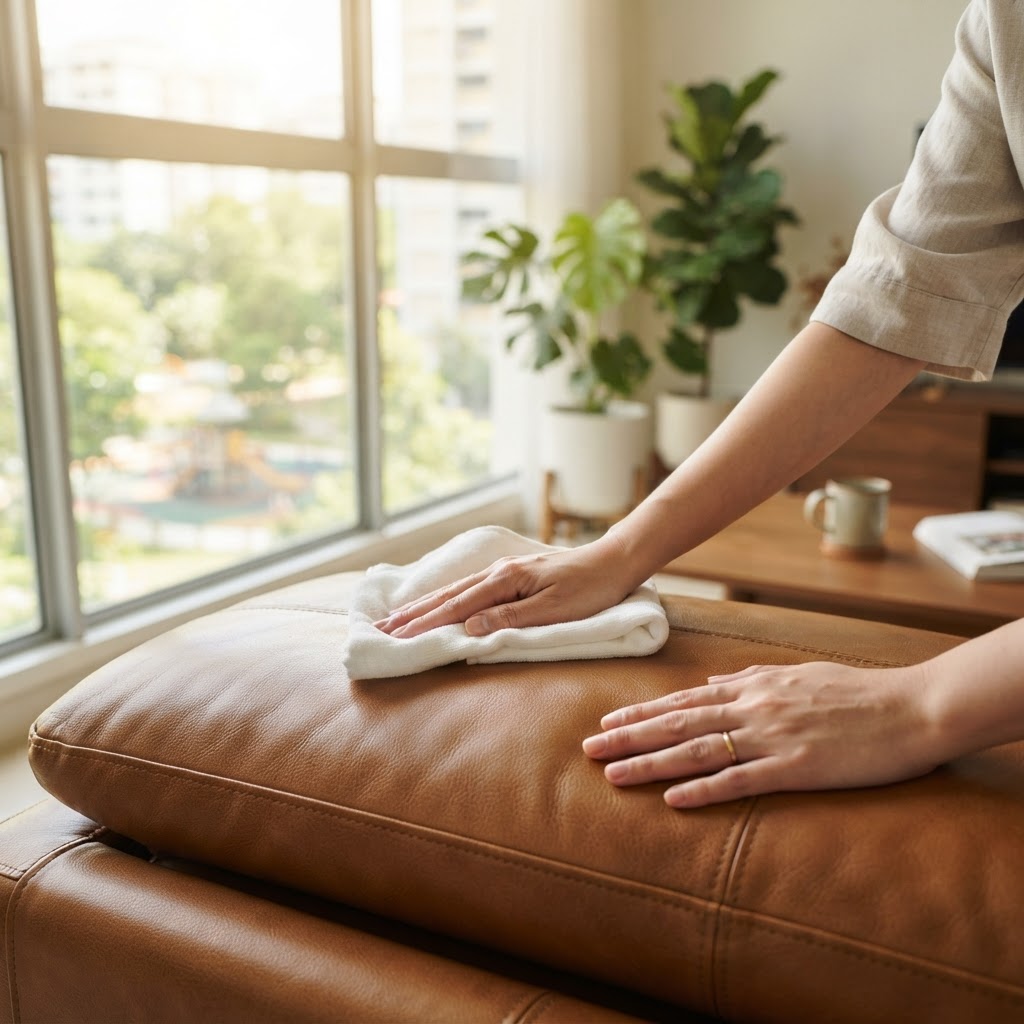
Leather couches are a popular choice in Singapore homes — from Bishan condos to Tampines HDB flats — thanks to their sleek look and perceived durability. But DIY cleaning a leather couch in Singapore comes with real risks that many homeowners discover only after the damage is done. This guide walks you through what you can safely do yourself, what to avoid, and when it genuinely makes sense to bring in a professional.
DIY cleaning a leather couch in Singapore is safe for routine surface wiping and light dust removal. However, Singapore's hot, humid climate accelerates cracking, mould growth, and dye transfer — meaning harsh DIY methods or the wrong products can permanently damage the leather. For deep stains, mould, or aged leather, professional cleaning is safer and more cost-effective in the long run.
Key Takeaways
- Start with gentle dry dusting. Use a lightly damp cloth only if the manufacturer's care instructions permit it for your leather finish.
- Avoid bleach, alcohol-based sprays, baby wipes, and vinegar — these strip the leather's protective coating.
- Singapore's humidity (average 80–90% RH) makes leather sofas especially prone to mould and cracking without proper conditioning.
- Always do a colour-fastness test on a hidden spot before applying any cleaning solution.
- DIY methods work for maintenance; deep stains, ink, pet accidents, and mould typically need professional equipment.
- Leather sofa cleaning is quoted after checking the sofa size, leather finish and condition. Send a photo for an assessment; fabric-sofa starting prices are not a confirmed leather-cleaning quote.
Understanding Your Leather Type Before You Clean
Not all leather is the same, and the wrong cleaning approach for your specific type can cause irreversible damage. The three most common leather finishes in Singapore homes are:
- Full-grain and top-grain leather — grain grade does not identify the surface finish. Finished, aniline and coated leather need different care.
- Aniline and semi-aniline leather — softer, more natural-looking, but highly absorbent and easily stained.
- Bonded or faux leather (PU) — the most affordable and common in Singapore rental apartments; peels with age and reacts poorly to harsh cleaners.
If you're unsure which type you have, check the manufacturer's label under the cushion or test a small hidden area before applying anything.
What You Can Safely DIY Clean on a Leather Couch
Weekly Dusting and Surface Wipe-Down
The safest and most effective DIY leather maintenance is also the simplest:
- Use a dry or lightly damp microfibre cloth to wipe down all surfaces weekly.
- For crevices between cushions, use a soft-bristle brush attachment on your vacuum — low suction setting.
- Wipe spills immediately with a clean, dry cloth. Do not rub — blot gently from the outside inward.
- Use a finish-compatible conditioner only when the manufacturer's guidance calls for it; follow the product instructions rather than a universal monthly schedule.
Handling Fresh Spills
Fresh liquid spills — water, juice, coffee — are manageable with quick action:
- Blot (never rub) immediately with a dry microfibre cloth.
- If a slight mark remains, dampen a cloth with distilled water and blot again.
- Let it air dry naturally away from direct sunlight or air-conditioning vents.
- Use a conditioner only if it is compatible with the finish and recommended by the manufacturer.
Mild Surface Staining
For light surface grime, use only a cleaner approved for the leather finish and follow the manufacturer's instructions. Test a concealed area first. Do not default to household soap, apply excessive moisture or saturate the leather.
What You Should NOT Do When DIY Cleaning Leather
These are the most common DIY mistakes Singapore homeowners make — and each one can cause lasting damage:
| What to Avoid | Why It's Harmful |
|---|---|
| Baby wipes or wet wipes | Contain alcohol and fragrance that strip leather coating |
| White vinegar | Too acidic; dries out and cracks leather over time |
| Baking soda paste | Abrasive; scratches surface and pulls colour |
| Rubbing alcohol / hand sanitiser | Removes dye and protective finish |
| Household bleach or disinfectant sprays | Causes irreversible discolouration |
| Olive oil or coconut oil | Attracts dust, darkens leather, turns rancid in humidity |
| Hair dryer to speed drying | Heat causes cracking and shrinkage |
Singapore's humid climate already stresses leather — introducing the wrong chemical accelerates deterioration significantly.
DIY vs Professional Leather Couch Cleaning: Honest Comparison
If you're deciding whether to go DIY or book a professional, here's a straightforward breakdown:
| Factor | DIY Cleaning | Professional Cleaning |
|---|---|---|
| Cost | Depends on manufacturer-approved products | Quote after checking the leather finish, size and condition |
| Suitable for | Light dust and fresh spills where the care label permits | Assessment of stains, mould, pet accidents and odour |
| Risk of damage | Wrong products or excess moisture can damage the finish | Depends on the finish and condition; discuss risks before treatment |
| Drying time | Follow the product and manufacturer instructions | Depends on the finish and treatment; confirm before booking |
| Mould removal | Avoid disturbing visible mould or spreading spores | Ask for a suitability assessment; do not assume complete removal |
| Equipment | Soft cloth or brush attachment where approved | Finish-appropriate leather products and methods after assessment |
| Result | Routine surface maintenance | Results depend on the finish and condition; stain removal is not guaranteed |
For regular homeowners in Singapore — especially those with kids, pets, or a couch that sees daily use — professional cleaning once or twice a year is genuinely worthwhile. If you're already researching what a proper service involves, the leather sofa deep cleaning service page explains the full process and what to expect.
How Singapore's Climate Affects Your Leather Couch
Singapore's average relative humidity sits between 80% and 90% year-round. For leather furniture, this creates two persistent problems:
Mould growth — Leather in poorly ventilated rooms (common in HDB flats with limited airflow, or condos where aircon is used intermittently) can develop mould patches within days of getting wet. If you spot white or grey fuzzy patches on your leather sofa, DIY cleaning is unlikely to fully address the root cause — mould penetrates the surface layer and requires targeted treatment.
Drying and cracking — Paradoxically, while the humidity is high, air-conditioning creates localised dryness. Leather placed near A/C vents dries out and cracks faster. Follow the manufacturer's care guidance; the appropriate conditioner and frequency depend on the leather finish.
If your leather couch has mould, a musty smell, or visible cracking from dryness, those are the clearest signals that DIY has reached its limit.
Step-by-Step: DIY Monthly Leather Couch Maintenance Routine
Here's a practical routine you can follow to keep your leather couch in good condition between professional cleans:
- Vacuum first — Use a soft brush vacuum attachment on low suction to lift dust from seams and cushion gaps.
- Wipe down all surfaces — Use a barely-damp microfibre cloth. Work in sections.
- Spot-treat any light marks — Use a manufacturer-approved cleaner for the finish, first tested on a concealed area. Avoid household soap recipes and excess moisture.
- Condition only when recommended — Use a compatible product if the manufacturer's guidance calls for it. Follow its application and drying instructions; do not use furniture polish.
- Check seams and undersides — Look for early mould signs, especially if the room has poor ventilation.
- Allow full air dry — Follow the product instructions and wait until the surface is fully dry before using the sofa.
This routine takes about 20–30 minutes and meaningfully extends the life of your leather couch.
When DIY Cleaning a Leather Couch Isn't Enough
Some situations call for professional intervention regardless of how careful your DIY technique is:
- Ink or dye transfer — Ballpoint pen, jeans dye, and marker stains penetrate leather and cannot be safely removed with household methods.
- Pet urine or vomit — The acid in pet waste degrades leather quickly and leaves persistent odour that surface cleaning won't eliminate. For guidance on handling pet accidents on upholstery more broadly, the article on cat urine on sofas covers this in detail.
- Mould infestations — Visible mould requires targeted anti-fungal treatment; simply wiping it off spreads spores.
- Old or set-in stains — A dried or set-in stain needs a leather-specific assessment before treatment. Do not assume fabric extraction or steam cleaning is suitable for leather.
- Cracked or peeling bonded leather — Requires specialist assessment before any cleaning is attempted.
If you're in Jurong, Woodlands, Sengkang, Punggol, or anywhere across Singapore, a professional team can come to you — there are no transport or location surcharges.
Cost and Pricing for Professional Leather Sofa Cleaning in Singapore
Leather cleaning requires a material-specific quote. Send clear photos of the whole sofa, the affected area and any manufacturer's care label, together with its approximate size. The provider can confirm suitability, the proposed method, price and likely drying time before an appointment.
The published sofa cleaning price guide contains starting prices for listed services; these should not be treated as a confirmed quote for your leather couch. Do not select a fabric extraction or hot-steam add-on for leather without a finish-specific assessment.
Singapore Service Areas
SofaCare SG operates island-wide, covering all major areas including East Coast, Bedok, Tampines, Pasir Ris, Woodlands, Yishun, Sengkang, Punggol, Serangoon, Bishan, Toa Payoh, Queenstown, Bukit Timah, Jurong, Choa Chu Kang, Clementi, and Holland Village. Whether you're in a HDB flat, condo, or landed property, there are no transport or location surcharges.
Conclusion: DIY Cleaning Your Leather Couch in Singapore Has Real Limits
DIY cleaning a leather couch in Singapore is a perfectly reasonable approach for routine maintenance — gentle dusting, fresh spill response, and any finish-compatible conditioning recommended by the manufacturer. Done correctly with the right products, it keeps your sofa looking good and extends its life.
But Singapore's humidity, combined with the day-to-day realities of pets, children, and heavy use, means most leather couches eventually accumulate staining, odour, or mould that household methods simply cannot address. When that point comes, professional deep cleaning is the honest solution — not a luxury. The process is thorough, priced transparently, and done on-site at your home across all of Singapore.
If your leather couch is past what DIY can fix, get a quote for professional sofa cleaning or reach out directly to discuss your specific situation.
WhatsApp us at +65 9025 9771 for a fast, no-obligation quote on your leather couch cleaning.