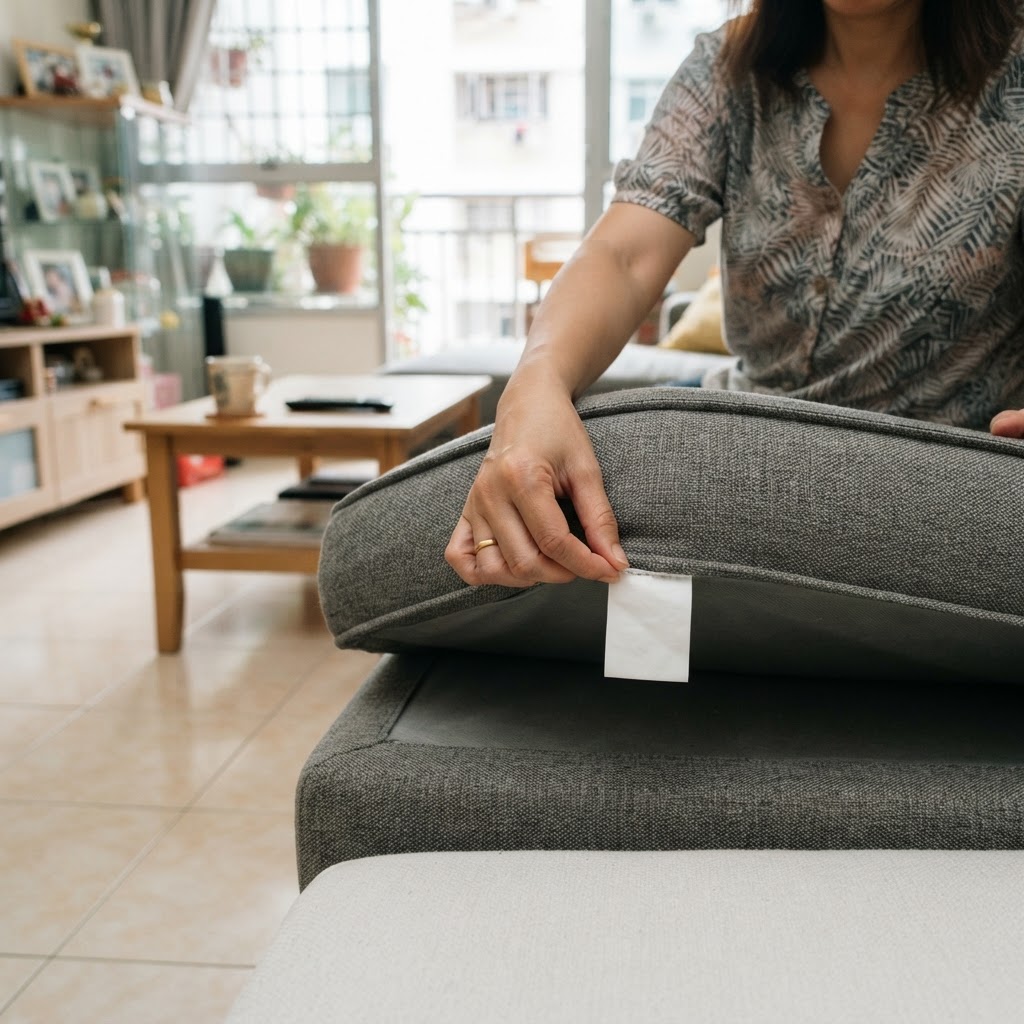
Sofa care label codes are the single letters printed on the small tag under a cushion or along the base of a sofa. They tell you which kind of cleaner the fabric can take. Before you spray anything on a stain, it is worth turning the cushion over and finding that tag, because the wrong product can leave a ring mark, shrink a cover or fade the colour.
Direct answer: W means water-based cleaners are fine, S means solvent-based cleaners only (no water), WS means either type can be used, and X means vacuum or light brushing only. If the tag is missing or faded, treat the fabric as the most delicate case and test first, or ask a professional to check it.
Key takeaways
- The code is usually on a tag under the seat cushion, on the sofa frame or in the original paperwork.
- W is the most forgiving code; X is the least forgiving.
- S fabrics can water-mark, so plain water and home sprays are a common cause of rings.
- Always do a small patch test on a hidden spot, even when the code allows the product.
- Humid Singapore homes make slow drying a bigger risk, so use as little liquid as you can.
- If you are unsure, send a photo of the tag and the stain before you treat it.
Where to find the care tag on your sofa
Most sofas have a sewn-in tag under one of the seat cushions. On fixed-cushion sofas it may be stitched to the underside of the frame, at the back of the base or inside a zip. Some brands print the code on the product sheet or on the furniture shop's website instead.
If you bought the sofa second-hand or the tag was cut off, look for the code on the receipt or the order confirmation. When none of these are available, assume the fabric is delicate. Our Sofa Cleaning Singapore team starts every visit with an inspection and a colour-fastness test for exactly this reason.
What each code means
| Code | What it allows | What to avoid |
|---|---|---|
| W | Water-based cleaners, mild soap and water foam | Strong solvents, harsh chemicals |
| S | Solvent-based (dry-cleaning) cleaners only | Water, steam, most home sprays |
| WS | Either water-based or solvent-based cleaners | Soaking the fabric |
| X | Vacuuming or light brushing only | Any liquid cleaner, water or solvent |
W: water-based cleaning is safe
W is the easiest code to live with. Many cotton blends and synthetic sofa fabrics carry it. You can blot fresh spills with a damp cloth and use a mild water-based upholstery foam. Even so, use a light touch: too much water can soak into the cushion foam and leave a tide mark as it dries.
S: solvent cleaners only
S fabrics react badly to water. A wet cloth can leave a pale ring or a dark outline around the stain, and the mark often looks worse than the original spill. These fabrics are cleaned with a dry-cleaning solvent instead. If you have an S sofa, skip the kitchen spray and the steam cleaner. Our article on whether dry cleaning is better for fabric sofas explains why solvent cleaning suits some fabrics.
WS: water or solvent
WS (sometimes printed S/W) means the fabric can take either type of cleaner. That gives you more options, but it does not mean anything goes. Pick the gentler method first, test it on a hidden spot and avoid soaking the cushion.
X: vacuum or brush only
X is the strictest code. The maker is saying that no liquid cleaner, water or solvent, should be used on the fabric. You can vacuum with a soft brush head and lightly brush off dry dirt. Anything beyond that, such as a drink spill or a pet accident, is a job to ask a professional about rather than treat at home.
Fabric types and the codes they often carry
The code always comes from the maker, so the tag wins over any general rule. Still, some patterns are common, and they help you guess what to expect before you find the tag.
| Fabric | Code you will often see | What it means in practice |
|---|---|---|
| Polyester and many synthetic blends | W or WS | Usually the easiest to spot-clean with a mild foam |
| Cotton and cotton blends | W or WS | Can shrink or water-mark if soaked |
| Microfibre and microsuede | S or WS | Water can leave rings, so solvent is often used |
| Linen and linen blends | S or WS | Prone to water marks and wrinkling |
| Velvet and chenille | S or X | Pile can flatten or crush when wet |
| Natural fibres such as silk or wool blends | S or X | Best left to a professional |
Treat this table as a starting point only. Two sofas made from what looks like the same fabric can carry different codes because of the dye, the backing or a finish applied at the factory.
Why the code matters more in Singapore homes
Singapore's humidity slows drying. A cushion that would dry quickly in a dry climate can stay damp for much longer in an HDB flat or condo with the windows closed, and a damp cushion is where musty smells and mould begin. That is one more reason to use the least liquid the code allows, and to dry the area well with a fan and good airflow afterwards.
If a sofa already smells musty after a home clean, it usually means moisture stayed in the cushion. Air the room, run a fan across the seat and keep the cushion off the floor so air can reach both sides.
How to spot-clean safely, code by code
- Find the code on the tag before you touch the stain.
- Blot, never rub. Use a clean white cloth so no dye transfers.
- Test the product on a hidden spot, such as the back or underside, and wait for it to dry.
- For W or WS, use a small amount of mild water-based upholstery foam and blot from the outside of the stain inwards.
- For S, use only a solvent cleaner made for upholstery, in a ventilated room, and never add water.
- For X, vacuum or brush only. Stop there and ask for advice.
- Dry the area with a fan and keep people and pets off it until it is fully dry.
If you want the full home routine, see how to clean a fabric sofa at home.
Can you steam clean any sofa?
No. Steam is water, so it is not suitable for S or X fabrics. On W and WS fabrics it can work, but heat and moisture still carry a risk of shrinking or water marks on some materials. Our article on whether steam cleaning can damage a fabric sofa goes through the risks in more detail. Leather sofas follow different rules altogether and are quoted from photos.
Common mistakes with sofa care labels
- Ignoring the tag because the spill looks small.
- Using a household all-purpose spray on an S or X fabric.
- Soaking a W fabric so the foam underneath gets wet.
- Scrubbing hard, which can fuzz the weave or spread the stain.
- Skipping the patch test because "the code says it is fine".
- Mixing products. If one cleaner did not work, do not layer a second one on top.
What to do if you already used the wrong cleaner
It happens often: a quick wipe with a wet cloth on an S fabric, or a household spray on a velvet cushion. If you notice a ring mark or a change in colour, stop and do not add more product. More water or a second cleaner usually spreads the mark further.
- Blot away any liquid still sitting on the surface with a dry white cloth.
- Let the area dry fully with a fan and good airflow.
- Take a clear photo of the mark in daylight, plus a photo of the care tag.
- Do not scrub, iron or use a hair dryer on high heat to speed things up.
Ring marks on S fabrics can sometimes be improved by cleaning the whole panel evenly rather than just the spot, but results depend on the fabric and we cannot promise a full fix. A photo lets us tell you honestly what to expect before you book.
Other things you may see on the tag
Besides the cleaning code, sofa tags often list the fibre content (for example 100% polyester or a cotton and linen mix), the country of manufacture and sometimes a reminder not to remove the tag. The fibre content is useful when the code letter has faded, because it gives a clue about how the fabric will react to water. Keep the tag attached and readable: it is the quickest way for anyone cleaning the sofa, including you, to pick the right method.
When to call a professional
It makes sense to get help when the code is X, when the tag is missing, when a home attempt has already left a ring mark, or when the stain has soaked into the cushion. A professional clean follows a set process: inspection and colour-fastness test, industrial vacuuming, targeted stain pre-treatment, deep injection and extraction, sanitising and odour treatment with fabric grooming, and a final inspection. The method is matched to the fabric, which is why we ask about the code first.
Cost and pricing
These are the starting prices listed on our pricing page for fabric sofa cleaning:
| Fabric sofa | Starting price |
|---|---|
| 1-seater | $60 |
| 2-3-seater | $87 |
| 4-seater | $107 |
| 5-seater | $127 |
| 3+2 set | $150 |
| L-shaped or sectional | +$20 |
Steam add-on is +$20. Leather sofas are quoted from photos. The final price is confirmed on WhatsApp from your photos.
Singapore service areas
We clean on-site at HDB flats, condos and landed homes across Singapore, and we are open 24/7. 3-hour call-out response within about 8 km of Punggol, Sengkang and Tampines. Same-day service for addresses beyond 8 km (the rest of Singapore).
Conclusion
Sofa care label codes are a quick way to avoid an expensive mistake. W allows water-based cleaners, S needs solvents only, WS allows either, and X means vacuum and brush only. Check the tag, test first, use as little liquid as you can, and dry the area well. When the code is X, the tag is missing or a stain will not lift, send us a photo of the tag and the stain with your sofa size and postal code.
WhatsApp Sofa Care Singapore at +65 9025 9771 for a quote.